An old city in a young state. A city marked by repeated shifts of identity throughout its history. And a city with a solid mix of East and West, old and new, worn and modern.
Bratislava is clearly worth a visit, but depending on your interests, two to three days are sufficient.
Slovakia is a young country as an independent state and spent decades living in the shadow of communism, and before that was dominated by Hungary, Austria, and Germany.
As a result, it is today clearly a bit of everything, and geographically it lies just minutes from both Hungary and Austria.
It is a small capital with only about half a million inhabitants, where tourism is concentrated in the Old Town, while local life unfolds elsewhere. There are large communist-era housing estates to explore, beautiful landscapes and monuments, and generally just everyday life without grand gestures.
And that is precisely the definition of the city: peaceful and both worn and modern, and at times also beautiful and interesting — but without making a big deal of itself.
How we travelled
We travel by train and public transport whenever it is possible and practical.
Using an Interrail Global Pass the journey began in Aarhus, Denmark, through Central and Eastern Europe, and ended in Kars, Turkey before moving on in a different way.
Interrail is not only for young people, but for all ages, and it can clearly be recommended. It gives you the freedom of changing your plans if needed and not having to plan every little detail in advance.
Setting it up is a bit cumbersome, but once everything is in place, it is very easy to use.
You pay based on how many travel days you expect to need. We purchased an Interrail pass with four travel days to be used within a maximum period of one month.
One travel day equals as many train journeys as you like—but be aware that if a journey passes midnight, it counts as an extra day.
After setting it up, you download the Rail Planner app, log in, and from there you can search for routes and departure times and add them to your trip. It is also your ticket to show.

* The Old Town
Quite charming, but also full of tourist traps and British stag parties. At times, it can be downright awful.
That said, it is possible to find good restaurants and bars, but doing your research is essential.
Spend no more than half a day here.
Note: You do not necessarily need to rely on public transport — it is easy to walk to most places. Otherwise, there are trams and buses available.
* Slavín
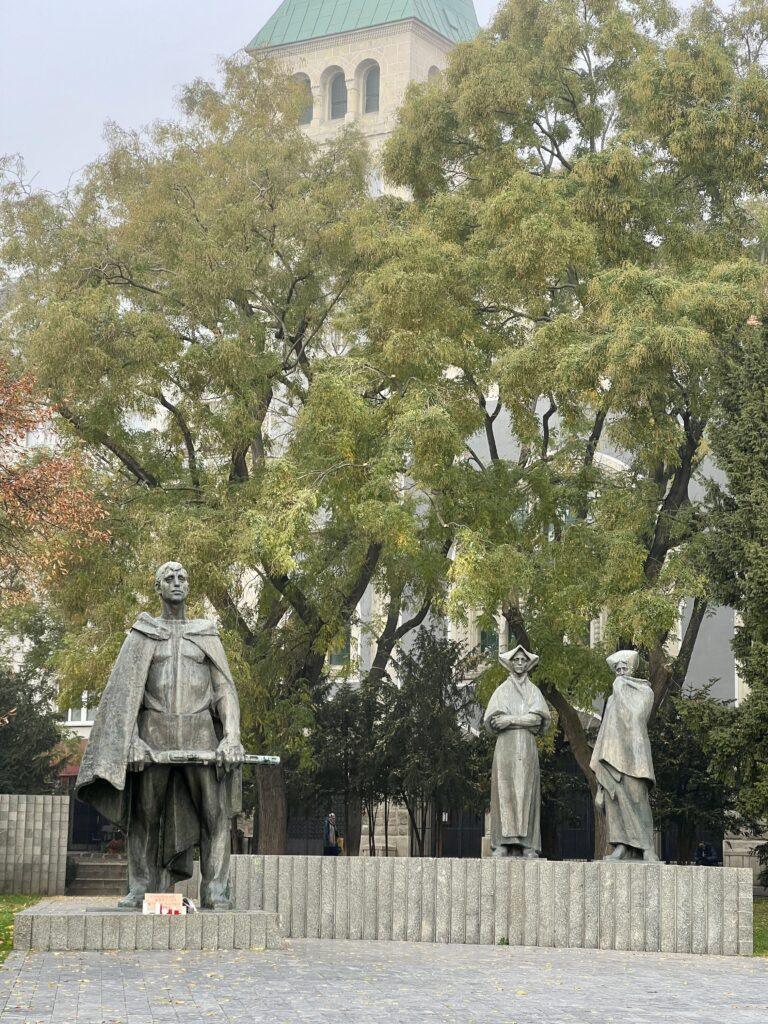
A large Soviet war memorial from World War II located just northwest of the city centre.
Walk through the villa neighbourhoods up into the hills and enjoy the beautiful houses as well as a fantastic view over the city.
The memorial itself is both historically interesting and visually impressive.
Solid, down-to-earth, and clearly shaped by Central European history.
The traditional cuisine is heavy, with dishes based on pork, potatoes, cabbage, and flour, often served in generous portions. Classics such as bryndzové halušky (potato gnocchi with sheep’s cheese) and schnitzel in various versions appear frequently.
Quality varies significantly: many places market themselves as “local” without necessarily delivering on that promise. On the other hand, prices are generally lower than in Western Europe, and wine — especially from the nearby wine regions — is a positive highlight.
Overall, Bratislava’s gastronomy is not spectacular, but filling and best experienced with realistic expectations and a bit of prior research. That said, there are small gems to be found here and there.
This isn’t a list of everything you can do in Instanbul and you won’t necessarily find all the major tourist attractions here. It’s rather a selection of places we’ve visited and personally recommend and rate.
🚂 Definitely worth a visit
🚂 🚂 Really good
🚂 🚂 🚂 One of our favorites
🚂 🚂 🚂 🚂 Above and beyond
🚂 🚂 🚂 🚂 🚂 Truly exceptional
Form Factory Nivy
Nivy Centrum Shopping Center
(Has its own entrance and is located on one of the upper floors)
Mlynské nivy 19034/5A
Nice centre. It is possible to purchase a day pass (not cheap).

Running
We did not have the chance to properly test it ourselves, but the best area for running is along the banks of the Danube.
There are long, continuous paths on both sides of the river, primarily asphalted and flat.
Via Airbnb, we found a relatively inexpensive one-bedroom apartment close to the Presidential Palace. Very nice and functional.

This section covers things, experiences, lessons, and moments that were either useful, funny, awkward – or just a bit random.
It also includes thoughts, impressions, or casual observations that may not necessarily be fact-checked but felt true to us in the moment.
* Slovaks are used to being confused with Slovenia, but they are also annoyed by it.
* For many Western Europeans, Bratislava is considered Eastern Europe (somewhat prejudicially), but it is in fact Central Europe.
* The distance to Vienna is only about 60 km — making them the two closest capital cities in Europe. During communism, Bratislava was a closed border city; the Danube effectively formed part of the Iron Curtain.
* Many locals commute daily to work in Austria — some earn their salaries in Vienna and drink their beer in Bratislava (it is way cheaper!).

It’s all about sharing our attempt to understand the world by experiencing it with our own eyes. Here and on multiple platforms, we talk about our experiences—the good and the bad—and we have an opinion on most things, which we are more than happy to share.

© All Rights Reserved.