Content:
3.a TimisoaraRomania was one of the absolute highlights of our two-month journey through Eastern Europe, Turkey, and the Caucasus in 2024/25.
Several people had told us to look forward to a beautiful country with great hospitality, and we were also eager to see a place that, at least for one of us, held memories of the dramatic events surrounding the break from communism and the fall of dictator Ceaușescu in 1989.
Our visit turned out to be a mix of disappointment, joy, and deep fascination over the course of eight days.
Let’s start with hospitality. Quite simply, we didn’t experience it—neither in the second-largest city, Timișoara, nor in the capital, Bucharest, nor on the journey there or back. Even though we really wanted to.
Whether it was on the train, in restaurants, on the streets, in shops, at bars, or in museums, it just wasn’t there. We were met with indifference, often close to being ignored, and unless we were paying for something, most people avoided eye contact and conversation as much as they possibly could—or at least that’s how it felt. At first, we didn’t understand why, but over time, we developed a theory.
The Time During and After Ceaușescu
For 24 years, Romania’s former dictator, Nicolae Ceaușescu, ruled the country alongside his wife, Elena (who, in reality, was the one pulling the strings).
The couple governed with brutal repression while living in luxury in a secluded mansion just north of the capital. Their disastrous economic policies, aimed at paying off the country’s foreign debt, led to widespread hardship. While they obsessively glorified themselves, they oppressed the people in countless ways, including:
By December 1989, the people had had enough.
The uprising began in the western city of Timișoara and quickly spread across the country. Ceaușescu’s response was to order his forces to open fire on the crowds—over 1,100 people were killed.
He and his wife attempted to flee by helicopter but were soon captured. After a rushed trial, they were both executed by firing squad. Their so-called trial and their bloodied bodies were broadcast on live television.
What should have led to freedom and progress instead resulted in decades of chaos. Many former communists remained in power, leading to corruption and slow reforms.
Very few were ever held accountable for their collaboration with the Ceaușescu regime or for crimes against the people. Even today, many official documents and case files remain classified.
In the early 2000s, Romania joined NATO and later the EU, and the country has since experienced significant economic growth. However, it wasn’t long ago that hundreds of street children were literally living underground in the capital.
Political instability and corruption remain issues, and while the communist era has been officially condemned, there is still debate over whether Romania has truly confronted its past.
No Closure
Our theory is that Romanians have never truly recovered from oppression and corruption, and they have never really found closure that would allow them to move on.
As a result, they can come across as a collectively subdued people who keep to themselves and look out for themselves, as they have been accustomed to for decades.
That said, it does seem that the younger generation behaves somewhat differently—they appear a bit more outgoing and in better spirits, though not in any dramatic way. Perhaps change is on the horizon. It should also be noted that in Eastern Europe, there is generally less smiling than we are used to, and people tend to come across as more reserved and serious. But Romania still took the prize. The overall attire of black puffer jackets, sweatpants, and sneakers didn’t help either.
If one is unsure whether a shift in mood is underway, it is absolutely clear that change and new times are on the rise in Romania—construction projects everywhere, newly renovated buildings, and entire city centers beautified. And if anyone still imagines that the car fleet consists of worn-out Škodas, Ladas, and Trabants, they are completely mistaken. It’s all new cars now, many of them luxury models. Apparently, that’s one of the first things people upgrade when progress comes their way—and it makes sense if you’ve never really had the means or the freedom for self-indulgence.
And there are plenty of them—the cars—especially in Bucharest, where the infrastructure can’t keep up, leading to constant chaos on the major roads, both during the day and well into the evening.
Something else we noticed, which ties into the above, is the strong desire to appear Western. Coffee shops, wine bars, and takeout places have sprung up everywhere in the cities, and while that is good in a way, it’s also a bit of a shame that there isn’t more of a distinct cultural identity. But again—where would it come from?
All in all, our trip to Romania offered a historical experience of great proportions and an exciting, simmering capital. But unfortunately, the people were not the highlight. We simply didn’t feel welcome in the way we did in many of the other countries we visited on this journey. And yet, it was one of the greatest experiences because it stood out so distinctly.


Bucharest is an intensely fascinating city, and in many places, both beautiful and grand.
It is clear that the city is on the rise – large construction projects and renovations are underway everywhere. However, like the rest of the country, it still bears the marks of decades of oppression under the dictatorship of Nicolae and Elena Ceaușescu and their secret police, the Securitate. We sensed a certain muteness and inwardness unlike anything we have encountered elsewhere, which we have reflected on here.
That being said, Bucharest is a metropolis with so much beauty to take in and so many places where history feels alive – from Ceaușescu’s megalomaniac projects like the grandiose Parliament building to aesthetic, almost Parisian architectural works, broad boulevards, as well as stunning parks, fountains, and monuments.
Like other major cities, it is divided into different areas, and not all are equally interesting. A good piece of advice is to avoid the old town – while it has beautiful buildings, they have been taken over by terrible restaurants and bars, as well as hordes of tourists searching for the next place to get drunk.
Instead, spend time in Piata Romana, where the atmosphere feels more authentic, and where you can find decent restaurants, bars, and coffee shops. Also, explore the area around Piata Victoriei, and especially Dorobanti and Floresca (northwest of Dorobanti) – our experience was that the further north we went, the more openness and warmth we encountered, even if still in small doses.
The traffic is horrendous everywhere – but gone are the worn-out Ladas and Skodas of the 1990s, replaced by a mostly brand-new fleet. It seems like everyone must own a car, preferably a new and large one, as a symbol of the country’s progress. Unfortunately, the infrastructure is clearly not equipped to handle the sheer number of vehicles.
Still, Bucharest is well worth a visit – you can easily spend a long weekend or even a full week here, depending on your interests. The city feels safe, you feel at ease, and it is perfectly manageable to explore on foot – perhaps supplemented by a bit of public transport.
This isn’t a list of everything you can do in Bucharest, and you won’t necessarily find all the major tourist attractions here. It’s rather a selection of places we’ve visited and personally recommend.
🚂 Definitely worth a visit
🚂 🚂 Really good
🚂 🚂 🚂 One of our favorites
🚂 🚂 🚂 🚂 Above and beyond
🚂 🚂 🚂 🚂 🚂 Truly exceptional
To avoid harming or calling out anyone, we only speak in general terms about our bad experiences. However, we do name and grade the better places—but only those we’ve personally visited.
🚂 Definitely worth a visit
🚂 🚂 Really good
🚂 🚂 🚂 One of our favorites
🚂 🚂 🚂 🚂 Above and beyond
🚂 🚂 🚂 🚂 🚂 Truly exceptional
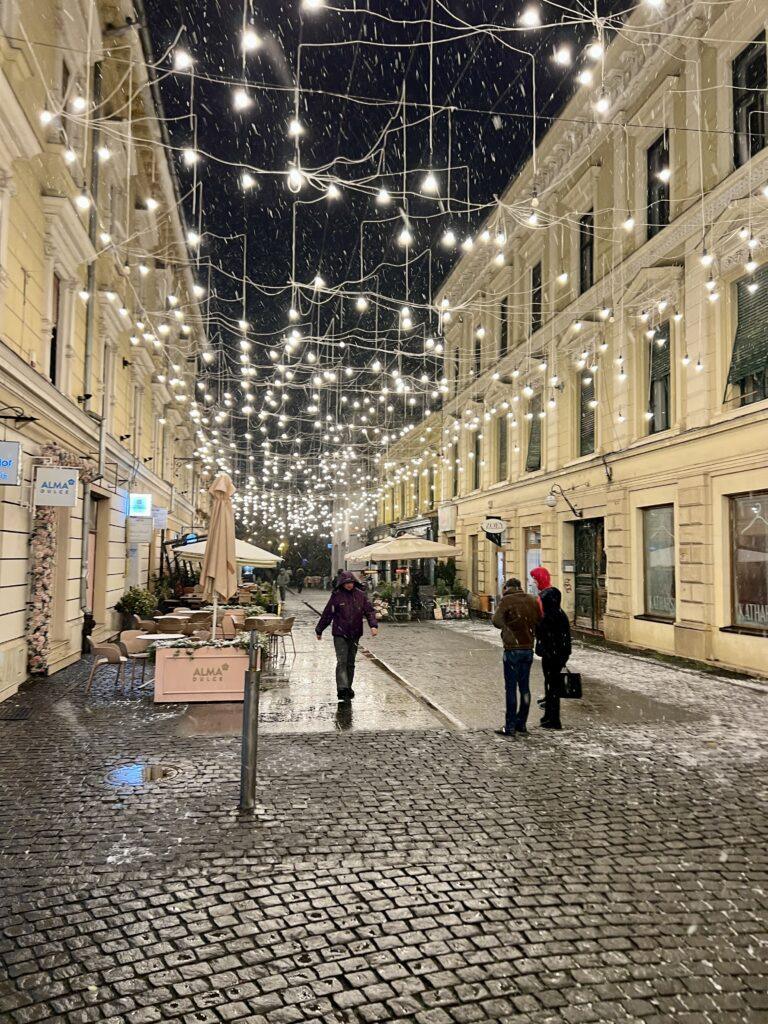


Timișoara in western Romania is the country’s third-largest city, with around 300,000 inhabitants.
It is known as a multicultural city with Romanians, Hungarians, Germans, Serbs, and other minorities, and at the same time as a modern city with many university students – something that is clearly visible in the streets, which are full of young people.
It has a rich cultural life as well as a lively bar and restaurant scene, mostly centered in a rather small city center that is elegant and well-kept, often referred to as “Little Vienna.” In several places it is so well-maintained or beautifully restored that it almost feels like a movie set.
We visited the city in November, and to say the least, not much was happening, but Timișoara is still an interesting place. Not least historically, since it was here that the revolution against dictator Ceaușescu began in December 1989 and quickly spread to the rest of the country.
The city has a small museum dedicated to the history of the revolution, which is worth a visit, even if the story is presented in an almost painfully dull way.
If you happen to pass through the area, Timișoara is definitely worth a stop – and we imagine it must look much better once spring arrives than it does in the winter months.
We visited a good handful of bars and restaurants during our stay, but the standard was neither impressive nor inspiring, which is why none of the places are mentioned here.
This heading covers things, experiences, and observations that have been useful, fun, embarrassing, or something else entirely. It can also include statements or claims that may not necessarily be fact-checked.
It’s all about sharing our attempt to understand the world by experiencing it with our own eyes. Here and on multiple platforms, we talk about our experiences—the good and the bad—and we have an opinion on most things, which we are more than happy to share.

© All Rights Reserved.