

We arrived in Istanbul after traveling through, among others, Slovakia, Hungary, and Romania in Eastern Europe, and one of the first things that struck us was the friendliness and smiles. Whether it was here or other parts of the country later in the trip, the same thing happened again – you encounter an incredible level of hospitality – that alone makes the country worth a visit.
There is much else that makes it worthwhile, though. The nature is fantastic – we saw a large part of it when we crossed the country to the east, heading toward Georgia. Snow-covered landscapes and views that constantly left us speechless.
And then there are the cities. They don’t have as much charm as the nature, in fact, especially the larger ones are far from pretty. It’s a massive collection of apartment blocks lined up both in the suburbs and the inner cities. It’s as if no one lives in anything other than apartments. That said, you can find a lot of charming neighborhoods.
In a huge city like Istanbul, life goes on 24/7, and it feels like at least some kind of diversity among the 16 million residents exists. But this is probably more for the tourists and their peace of mind, because in the rest of the country, you don’t really encounter it – there, it’s Islam and cultural gender norms that dominate, for better or worse. When you see a social gathering or a driver, it’s always men.
That’s something you must accept when visiting Turkey, just as you must accept another religion and the loudspeakers on every minaret, constantly, even at night, reminding everyone what to believe. Also, you need to respect and accept the fact that everything here is far from what it’s like in Western Europe or the USA.
But if you do respect – and of course you do – the local culture, religion, and customs, you’ll feel nothing but welcome in Turkey. As long as you don’t speak ill of the president Erdogan or mention the Armenian Genocide, which, of course, you don’t do while you’re there.


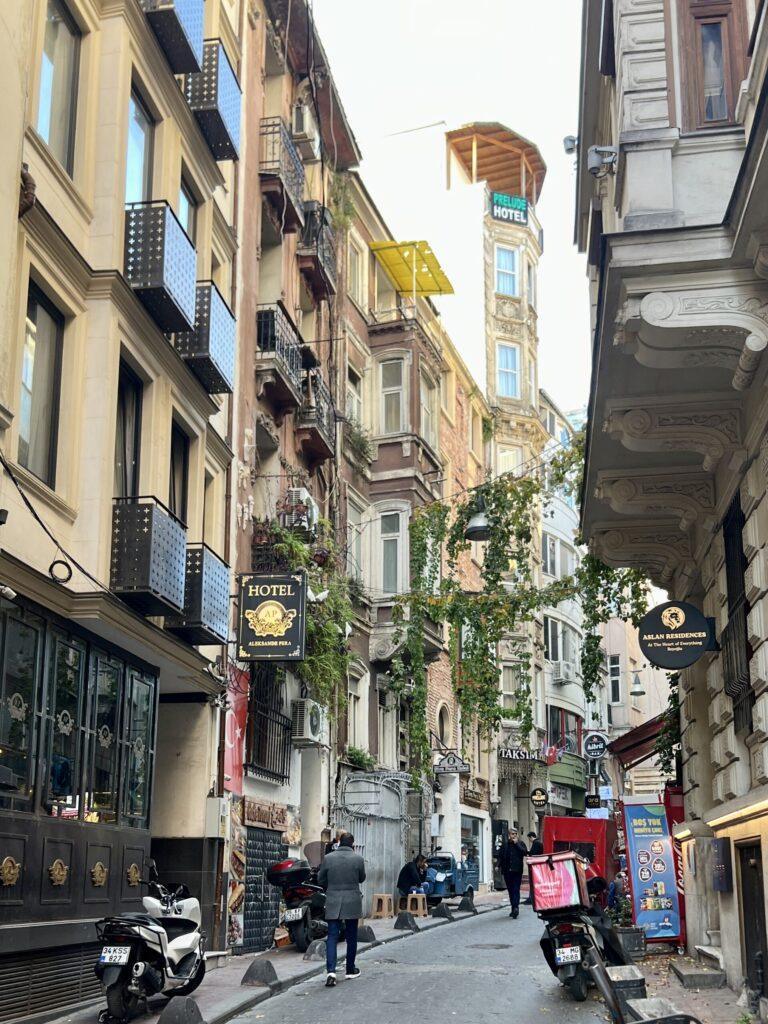


Welcome to the world’s 15th largest city – a massive place that is almost impossible to grasp, which goes without saying.
That’s why it’s worth doing at least some research on the different districts beforehand and maybe choosing a few to explore rather than trying to see it all – which is simply impossible.
The city is split in half by the Bosporus Strait, with the western part located on the European continent and the eastern part on the Asian side.
Istanbul is furthermore divided into several major areas, and based on what we had read, we rented an Airbnb in the Beyoğlu district on the western shore – and luckily, we chose right. While parts of it are touristy, behind the main streets and attractions, we found charming little neighborhoods full of local life and decent places to eat and drink. Together with the Karaköy district, it’s a bit like Istanbul’s version of a hipster area. And let’s be honest – we’ve realized that we might just be hipsters ourselves.
Now, don’t assume that the western shore feels like Western Europe and the eastern shore like Asia – that couldn’t be further from the truth. It’s all very Turkish, but the western side has far more tourists, which means it also has a more Western feel, with alcohol, coffee shops, and shopping.
The Sultanahmet district, in particular, is packed with tourists since many of the major attractions are here. A good tip if you want to visit them: Get in and out quickly – unless you love overpriced, mediocre food and persistent street vendors trying to lure you into their “special” restaurant.
Take a ferry across the strait, and on the other side, you’ll find the Kadıköy district. Here, you’ll discover an incredible selection of Turkish restaurants and lively local street life – completely different from the other side of the water.


Transport in Istanbul – buy an Istanbulkart
Istanbul has an excellent public transportation system, and you can buy an Istanbulkart, which is valid for almost all modes of transport – including ferries and trams. It can be purchased from a vending machine.
We bought ours at the Halkali train station, where we arrived. From there, we could travel easily with Marmaray and buses to Beyoğlu, where we were staying.
One card is enough, as it can be used by multiple people. You can top it up at most stations.
Use the ferries when you need to cross the Bosporus Strait – it’s convenient and a fun experience.
Marmaray is a train connection similar to an S-train/metro that runs throughout the southern part of Istanbul, linking the two continents, from the far west to the far east.

Our experience is that Istanbul is not a city packed with must-see attractions. The ones that do exist can be covered relatively quickly. To us, the real highlight is simply walking, driving, sailing, and exploring local life in some of the charming little neighborhoods scattered around the city.
That being said, there are a few things that might be worth seeking out:
This isn’t a list of everything you can do in Paris and you won’t necessarily find all the major tourist attractions here. It’s rather a selection of places we’ve visited and personally recommend and rate.
🚂 Definitely worth a visit
🚂 🚂 Really good
🚂 🚂 🚂 One of our favorites
🚂 🚂 🚂 🚂 Above and beyond
🚂 🚂 🚂 🚂 🚂 Truly exceptional
To avoid harming or calling out anyone, we only speak in general terms about our bad experiences. However, we do name and grade the better places—but only those we’ve personally visited.
❤️ Definitely worth a visit
❤️❤️ Really good
❤️❤️❤️ One of our favorites
❤️❤️❤️❤️ Above and beyond
❤️❤️❤️❤️❤️ Truly exceptional
We are not blown away by Turkish cuisine, but there are certain elements that are simply great. And often, these are the ones we already know from Turkish eateries or restaurants in the West.
On the other hand, the dishes here are often so simple that, as long as they are made with quality ingredients, they turn out absolutely perfect.
In general, Turkish gastronomy is a rich and diverse blend of flavors influenced by both Europe and The Middle East.
If you look for restaurants like in Western Europe with fine dining and western atmosphere you are in the wrong place.
Here, you often find small places serving local dishes – and often without alcohol on the menu. Typically, there are kebabs – shish grilled on skewers, or Iskender which is meat served with yogurt and tomato sauce.

Then, of course, there is Doner Kebab or wraps, which are great, especially for lunch, and various grilled lamb dishes or dumplings for dinner.

Also well-known are Mezes – a wide selection of appetizers, such as different spreads and dips, as well as stuffed vine leaves. In many places, you choose your mezes at the counter and order your main course from the menu. If the restaurant serves alcohol, people often drink Raki – a strong anise-flavored drink similar to Greek Ouzo.
There is also a large variety of soups, such as lentil soup, and for dessert, you can enjoy Baklava, a type of pastry, or Lokum (Turkish Delight). And, of course, Turkish coffee or tea.


4a. The Dogu Express
(Dogu ekspresi)
This is a train going from Ankara to the small town of Kars in eastern Turkey.
It’s a route that is becoming increasingly popular, making it difficult to get tickets—especially if you want a sleeping compartment, as there are only 2-3 carriages with those. But trust us, you’ll want one, because the journey is slow and takes a full 24 hours—and that’s without delays, which you can safely expect to be at least a couple of hours.
However, if you have a sleeping compartment, the trip is absolutely worth it!


How to Book Tickets for The Doğu Express
We had significant trouble booking at first, and we discovered that it’s because men and women are not allowed to share a compartment unless they are alone. Additionally, we couldn’t book an entire compartment for two people online.
In the end, we emailed info@ambertravel.com, and we quickly secured a private compartment—possibly because we traveled in November, when demand isn’t as high.
Keep in mind that if you are traveling with Eurail/Interrail, it cannot be used for this journey. The ticket must be purchased separately and costs for a private compartment €140 (2024).
Be aware that there are two types of departures – a special tourist departure and a regular one. The tourist version is more expensive, takes longer, and stops at selected sightseeing spots.
Once you’ve settled into the slightly worn-out compartment, the first thing to do is make up your bed so you can sit or lie comfortably and enjoy the stunning scenery unfolding as long as there’s daylight.
The train passes through one breathtaking landscape after another, and the morning views are absolutely spectacular—you’ll realize this when all the Instagrammers have taken over every window in the corridor.
There’s a dining car on board, which is fine for a simple meal or a coffee, but keep your expectations low.
And if the food and drinks are basic, the toilets are on an entirely different level—rock bottom. They are already disgusting at the start of the journey, and needless to say, things only get worse. It’s unbelievable that they can’t be kept clean—by either passengers or staff—but that’s just the reality.
Pro tip: Bring toilet paper and hand sanitizer—you’ll need it. Also, be prepared to wipe your shoes, because when you brush your teeth or do anything else, you’ll quite literally be standing in urine.
How We Got to Ankara from Istanbul
We took the high-speed train from Söğütlüçeşme in Istanbul to Ankara, which took about 4.5 hours. The journey counted as a travel day on our Interrail pass, but we had to book seat reservations separately at the station the day before departure.
In Ankara, we arrived at the new train station, but to find the Doğu Express, you need to go to the old station right next door. Ask around, as the platform information on the screens isn’t always correct. Also, look for the train itself—if we had waited 30 minutes longer on the wrong platform, we would have missed it!
If you’re really unlucky—and we speak from experience—you might end up in a compartment next to a couple of over-sized men, who smoke constantly (just like the conductor) and make noise pretty much the entire journey (just like the conductor) in every possible and sometimes rather unpleasant way.
And yet, despite all the above, it’s an absolutely memorable trip. The key is to bring the right amount of food, drinks, and essentials—like a pair of earplugs—and to manage your expectations. Anticipate everything we’ve described here, and you’ll be prepared not to be disappointed. Then, just sit back and enjoy a cozy mode of travel, a unique view, and an unforgettable journey across Turkey.
4b. Kars
Kars is a historic city in northeastern Turkey, near the Armenian border. It has a little more than 90.000 inhabitants and is known for its harsh winters and stunning landscapes.
It sits at an altitude of about 1,800 meters and has a rich history influenced by Armenian, Russian, and Ottoman rule, reflected in its unique and diverse architecture. The city has a distinct Russian architectural style, a legacy from its time under Russian control from 1878 to 1920.
One of its main attractions is Ani, the ruins of a medieval Armenian capital, often called the city of 1,001 churches. Kars Castle, overlooking the city, offers panoramic views – from there you can see into Armenia, and with a little imagination it’s almost as if you see into both Iran and Georgia as well. Alle three countries borders close by with Turkey.
Kars is especially famous for its Kars gravyer cheese, a type of aged cheese similar to Swiss Gruyère. There is a cheese shop on almost every street, and the city center is charming but also worn down.
Today, Kars is a gateway for visitors like us traveling on the Doğu Express, and despite its remote location, Kars remains a cultural and historical gem in Turkey. It’s worth a visit, but 1-2 days here is enough.


When You Arrive in Kars
The train arrives late in the evening, so it’s wise to have your accommodation booked in advance. We had reserved a room at Gran Ani Hotel, a four-star hotel with a spa, as we wanted to treat ourselves after weeks of traveling by train and staying in Airbnb’s.
It was a bit of a walk to the hotel, but we needed the exercise and chose to ignore the taxis waiting outside.
Are you continuing to Georgia?
After a night in Kars, we took a bus to the Turkish town of Hopa.
Head to the bus station in Kars, find the Yeşil Artvin Express office, and ask for a ticket to Hopa. Our bus left around 10 AM and took 6.5 hours. If you’re staying a day in Kars, book your ticket the day before; otherwise, arrive early to find the office and secure your spot.
The journey in the bus was long, winding, and full of sharp turns—several people on our minibus got carsick, so be prepared. That said, the scenery was absolutely breathtaking.
There’s a break along the way, but bringing your own food and drinks is a good idea.
Once in Hopa, cross the street from the bus stop and ask for a minibus to Sarp. It’s a short 30-minute ride, and you pay onboard.
At Sarp, you’ll find a border crossing that feels a lot like an airport. get dropped off at the entrance and walk through passport control.


ï Turkey is indeed part of Europe, but don’t expect it to be like the rest of Europe – especially when it comes to alcohol. It is not a common part of daily life here, and most restaurants don’t serve it at all. Exceptions are parts of Istanbul, but even here, it is still common not to have it. And we got along just fine without it.
ï On the other hand, tea is a huge part of daily life. Turkey is reportedly the most tea-drinking country in the world, and they’ll almost look at you strangely if you don’t have it after a meal or when you arrive at a hotel. By the way, they make great tea, and you actually get a bit addicted to it while you’re there.
ï Another part of everyday life is smoking. Men in Turkey smoke like chimneys, and it is still allowed to smoke in restaurants, cafes, and many other places. And if it’s not allowed, they’re usually completely indifferent to it. Expect your bus or taxi driver to light a cigarette as soon as the engine starts.
ï When you visit Istanbul, expect to go through security checks everywhere. In large stores, at tourist attractions, and even at a promenade by the sea. But be glad they are looking out for you rather than being annoyed by it.
ï If you’re a coffee drinker, you should try Turkish coffee, which stands out significantly from the coffee brewing in our part of the world. It’s finely ground coffee mixed with water in a small copper pot and slowly heated. It is served in small cups, where you let the coffee grounds settle at the bottom.
ï Istanbul is a city full of cats – a fun change when you’ve just traveled through a series of countries that are dog cities. In Istanbul, there are feeding stations in many places, and at bars and restaurants, they often take up part of the seating areas.
ï Turkey is famous for its traditional hammams or Turkish baths. They were once an essential part of social life and still offer a relaxing and cleansing experience with a scrub-down and massage.
It’s all about sharing our attempt to understand the world by experiencing it with our own eyes. Here and on multiple platforms, we talk about our experiences—the good and the bad—and we have an opinion on most things, which we are more than happy to share.

© All Rights Reserved.