Content:
2. The Capital
2a. Things we did or saw
2b. Where we wined and dined
3. Gastronomy
4. Outside the Capital
4a. Batumi
4b. Kutaisi
4c. Tskaltubo
4d. Bojormi
4e. Wine Country
5. Random
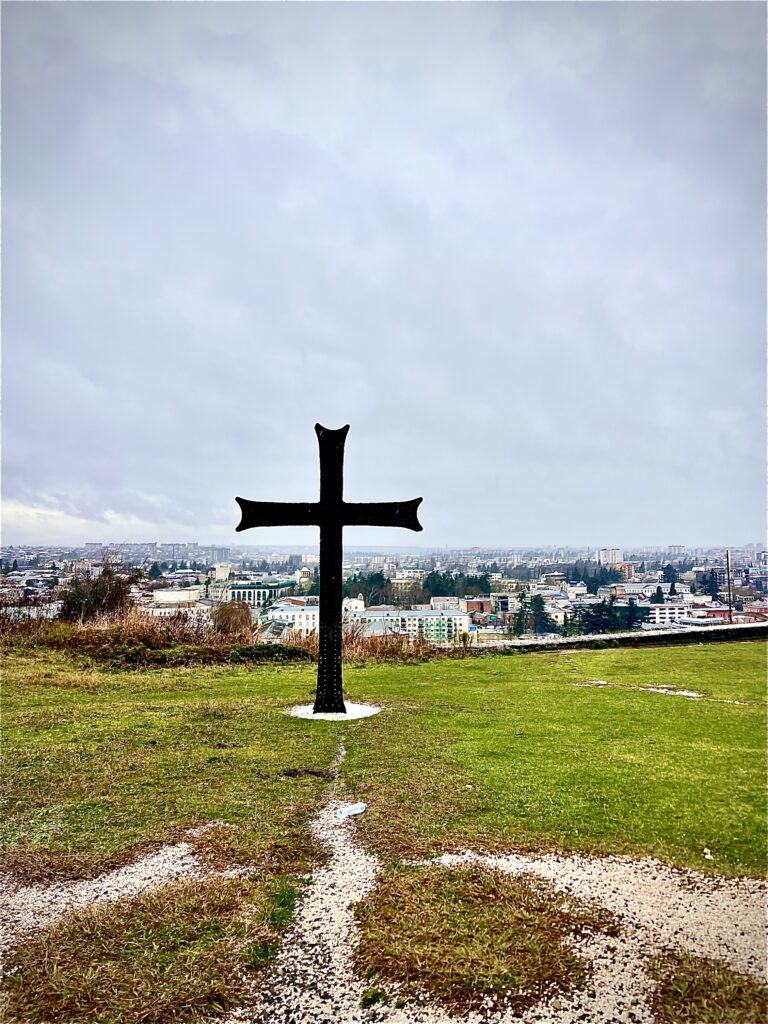


We had always known the name and that it was once part of the old Soviet Union, and that it was a country on the board in the game Risk. But that was about the extent of our knowledge of Georgia.
It wasn’t until we had an excellent Georgian meal and wine at a restaurant in Aarhus, Denmark that we realized this might be a country with a lot to offer.
When we later spoke to acquaintances who had been there and spoke warmly about it, we had no doubt—we had to go to Georgia. That decision shaped our travel plans for the winter of 2024, which ended up unfolding in three stages: first, a month-long train journey through Eastern Europe and Turkey; then, a month of traveling through Georgia, Armenia, and Azerbaijan; and finally, two months of “everyday life” in Paris—but that’s another story you’ll soon be able to read about here on the site.
Back to Georgia, which we had read a lot about beforehand and heard even more about in the lead-up to our journey, as unrest in the country was escalating. Not the kind of unrest that meant one couldn’t or shouldn’t travel there, but rather daily protests, often clashing with police, which we were advised to stay away from
In short, the ruling party, Georgian Dream, postponed negotiations on EU membership and pursued an increasingly pro-Russian policy throughout 2024. As of now (February 2025), nothing has changed, and protests continue daily for the third consecutive month in several major cities.
Read more about the conflict and stay updated here.
We had been told by many—and read in several places—that the Georgian people are extremely warm-hearted and that we should look forward to meeting them. We did, but that wasn’t exactly the first impression we got.
Crossing the border from Kars, Turkey, was pure chaos and left us slightly shocked. If you don’t have a car, you have to cross on foot, similar to going through passport control at an airport.

At first, everything seemed orderly, with people patiently making their way toward passport control with luggage and passports in hand. But around the corner, the reality was entirely different. Hundreds of people were scrambling to find their place in various lines, with no signs or barriers to guide them—it was simply about pushing your way to the front.
Before we knew it, we were surrounded by shoving, aggressive, shouting people, all desperate to be first. Arguments broke out, and at one point, a man and a woman even got into a physical fight until the police separated them.
There we stood, armed with our Danish sense of orderly queuing—useless in this situation. If we wanted to move forward, we had to fight, so we did. Along the way, we had to push, yell at people trying to cut in, block those behind us, and endure scolding shouted in our faces or over our shoulders. Some mothers used their children as shields and battering rams to get ahead, while elderly men and women just plowed through everything in their path, undeterred even when they were shoved or shouted at.
Somehow, we made it through. Exhausted, sweaty, and out of breath, we took a moment to compose ourselves on the other side, where everything suddenly felt peaceful and calm again.
Extreme warmth and kindness? Not exactly. And that wasn’t something we would say characterized Georgia in general. Yet, in the end, we grew to love both the country and its people.
How We Traveled:
There are flights to Georgia’s capital, Tbilisi, but otherwise, for Westerners, the only way in is via the border with Turkey.
There are multiple border crossings, but we chose the one at Sarp/Sarpi in Georgia’s southwestern corner since our first stop was the city of Batumi.
We started with the Dogi Express from Istanbul to Kars in Turkey (an adventure in itself—more on that later). After a night in Kars, we took a bus to the Turkish town of Hopa. If you’re doing the same, head to the bus station in Kars, find the Yeşil Artvin Express office, and ask for a ticket to Hopa. Our bus left around 10 AM and took 6.5 hours. If you’re staying a day in Kars, book your ticket the day before; otherwise, arrive early to find the office and secure your spot.
The journey was long, winding, and full of sharp turns—several people on our minibus got carsick, so be prepared. There’s a break along the way, but bringing your own food and drinks is a good idea. That said, the scenery was absolutely breathtaking.
Once in Hopa, cross the street from the bus stop and ask for a minibus to Sarp. It’s a short 30-minute ride, and you pay onboard. FOTO 474
At Sarp, you’ll find a border crossing that feels a lot like an airport. get dropped off at the entrance and walk through passport control.
On the other side, in Sarpi, you’ll be met with a chaotic mix of taxis and minibuses. We jumped on a city bus without knowing if it was the right one—but it was! It took us straight to Batumi’s city center in about 40 minutes. We couldn’t buy tickets onboard, but we took our chances, and it worked out.
Georgia was clearly feeling the impact of ongoing protests. A pro-European country, most of the people we met were fiercely fighting against a shift away from the EU. They were determined never to return to Russian dominance. However, in some remote villages in the mountains, we did see small pockets of people who felt differently.

We encountered some kindness in places, but overall, Georgian hospitality wasn’t what we expected. It wasn’t the warm, welcoming embrace we’d heard about. In many shops and restaurants, there was an air of indifference—not just toward us but toward everyone. Yet, again, in those same mountain villages, we saw the opposite.
Georgia has a strong-willed people with a wild history. They are completely their own—despite being a small country, they have a distinct identity and way of behaving. Their mannerisms are unusual—not many smiles, a touch of apathy, even a hint of laziness, but mixed with fiery tempers, resilience, and an unshakable survival instinct. They are proud, knowledgeable, and deeply cultured. Unlike many nations that revere military leaders or politicians, Georgians admire thinkers, writers, artists and musicians.
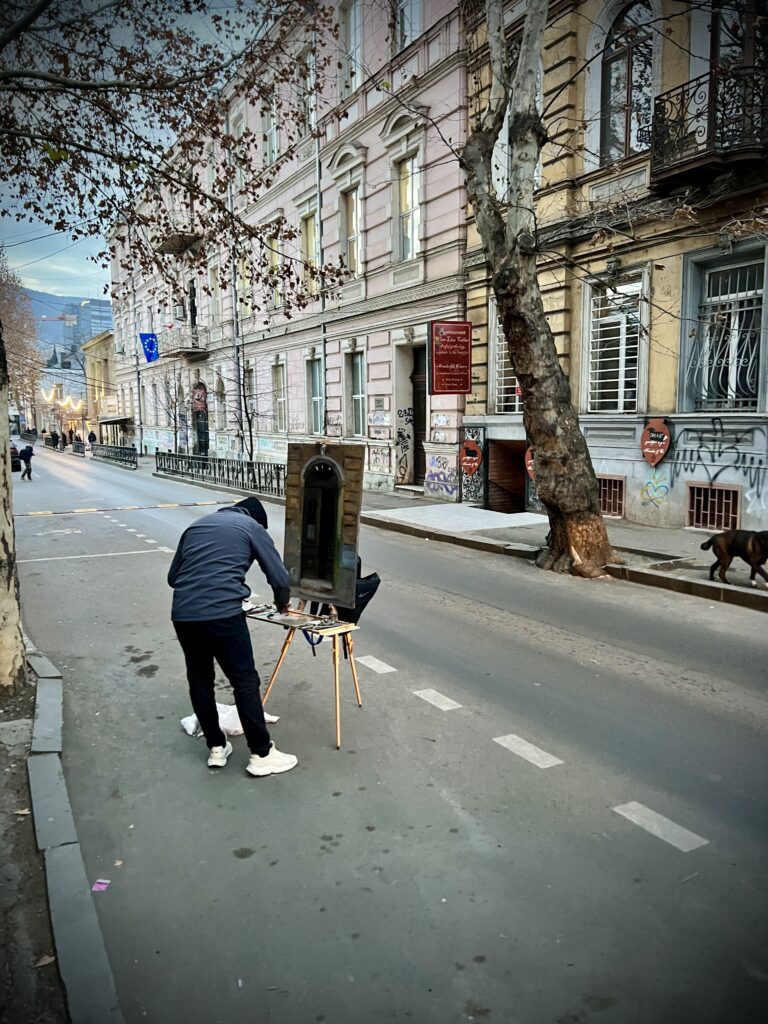

Nature-wise, Georgia is breathtaking, but there’s a big problem—it’s absolutely covered in trash. Plastic bags and bottles litter the landscapes, making it hard to ignore. That said, if you can look past the mess, the nature is spectacular.
City centers are relatively clean, but you wouldn’t call them beautiful. There are crumbling sidewalks, broken roads, and a mix of depressing modern buildings alongside once-gorgeous historical structures that have been left to decay. Decades of hardship since the fall of the Soviet Union are painfully visible.
Traffic in and around Tbilisi and other major cities is insane. It’s constant chaos, and the exhaust fumes are just as unpleasant as the trash situation.
And yet, despite all of this, Georgia is an absolutely incredible country. It’s hard to put into words why, given what we’ve just described—but maybe that’s exactly it. It’s a country full of soul, fight, and unforgettable experiences waiting for those who visit.

Contradictory? Absolutely. But that’s the feeling that still lingers in our minds.
Of all the countries we traveled through on this trip—Germany, Slovakia, Romania, Hungary, Turkey, Georgia, Armenia, and Azerbaijan—it was Georgia that left the biggest impression, both good and bad.
We found that walking was the best way to get around while getting our bearings.
Alternatively, we used the Bolt app, which is like Uber. You’ll need to register, and it’s helpful to link a credit card for easy payment. Heads up: Bolt rides are often priced so low that some drivers can’t make a profit, especially on longer, cheaper routes. If a driver asks for extra cash up front, it’s not a scam—it’s survival. Either choose a pricier ride or be open to negotiating.
We also found that Tbilisi has a good metro and bus system, and you can buy tickets or a transport card at metro stations.

Tbilisi is a multicultural city, likely due to its history as a key stop along the Silk Road, where merchants from all over the world once passed through. Although Georgia is predominantly Orthodox Christian, Tbilisi is also home to synagogues and mosques.
However, the demographics are not quite as diverse—there’s little racial diversity, and LGBTQ+ life remains underground due to the country’s conservative nature. That said, we heard it thrives beneath the surface.
You’ll see far more female drivers here than in the rest of the Caucasus, but they’re still a minority. Despite all the above, the city is constantly bustling with life, and there’s an endless array of food, drinks, and nightlife options.
The best time to visit is definitely in the spring or summer, when the trees are green and the city feels more alive. We were there in December, and honestly, it was cold and gray.
Tbilisi is a mix of everything—from gorgeous architecture and lovely parks to a heavy Soviet-era atmosphere with gray apartment blocks, crumbling roads, and chaotic traffic. Traffic is a nightmare, constantly congested with exhaust fumes. The buildings are a mix of stunning old structures and neglected ruins. Despite all this, the city has so much soul—you just have to look past the rough edges.


We booked an Airbnb in Marjanishvili, which we found to be the best neighborhood in town. It has an artsy, bohemian vibe —r elaxed but still lively, with great connections to the rest of the city.

One of the best things we did was explore the courtyards. Some of the city’s real life happens there—laundry lines crisscrossing between balconies, old men chatting, stray dogs roaming, kids playing football. If you’re lucky, you might even spot an old, abandoned Lada.
Tbilisi is a city of contrasts, history, and resilience. It might not be the most polished destination, but it’s rich in character and with a special soul.


We needed a moment to adjust to Tbilisi—it’s unlike any other city we’ve visited. But just like the country itself, it grew on us day by day until we absolutely fell in love with it. Now, we can’t wait to return someday.
Tbilisi is a huge city, sprawling across a vast area with many distinct neighborhoods, each with its own vibe—some livelier and prettier than others.
If you read about Tbilisi elsewhere, you’ll find descriptions of Rustaveli Avenue as grand and elegant, but that wasn’t quite our experience. We could see traces of its former splendor behind the smashed and boarded-up shop windows, the protest slogans painted on nearly every wall—then blacked out by the authorities.
We needed a moment to adjust to Tbilisi—it’s unlike any other city we’ve visited. But just like the country itself, it grew on us day by day until we absolutely fell in love with it. Now, we can’t wait to return someday.
Tbilisi is a huge city, sprawling across a vast area with many distinct neighborhoods, each with its own vibe—some livelier and prettier than others.
If you read about Tbilisi elsewhere, you’ll find descriptions of Rustaveli Avenue as grand and elegant, but that wasn’t quite our experience. We could see traces of its former splendor behind the smashed and boarded-up shop windows, the protest slogans painted on nearly every wall—then blacked out by the authorities.


The massive protests and clashes between police and demonstrators in late 2024 had left their mark. It wasn’t the most aesthetic version of the city, but full marks from us for the demonstrators’ cause, courage, and determination.
Read here – why we chose to participate in the protests. And read about the conflict here.
That said, life carried on as usual—just with far fewer tourists, which meant businesses were struggling.


Other sights worth visiting include Mtatsminda for panoramic city views, The Clock Tower, Tbilisi Cable Car, and the imposing Sameba Cathedral.
We only mention places we actually tried and liked.
What a cuisine! Exciting and different in so many ways.
If you’re vegan or gluten intolerant, forget about it, but if you’re vegetarian, it’s doable, though definitely not the focus.
Time seems to stand still here, and the focus isn’t just on the meat but also on the quantity of food. To understand that, we need to first tell you about the Supra – a Georgian phenomenon that’s about much more than just food.

A Supra is essentially when people gather around a table where food and drinks must never be missing, and everything is shared. It’ not essential how good the food is; it’s more about the whole experience with the company. It’s all about joy, respect, and community.
Guests must not only be fed and watered but also entertained – with laughter, dancing, and singing, sprinkled with good and respectful discussions. And speeches.
For all of this, there’s a toastmaster – the tamada – at the head. Unlike in Denmark, where a toastmaster coordinates speeches at a wedding, here the tamada is more like a conductor. He can’t be too much, but not too little either. He can’t be too boring, but not too festive. He can’t speak too little, but also not too much. He’ll give speeches himself, and they must hit all the right notes – a good Supra is only as good as its tamada. He’s the one everyone talks about the day after. (Sometimes, it’s a woman, but that’s rare and only in recent times).
The tamada’s job is also to toast, and there can never be too many toasts. Often with a poetic or loving message that fits the reason for the gathering. If the tamada invites, guests may also offer their own toasts, sharing their thoughts on perhaps the previous toast and its subject. Respectfully. You always accept such an invitation, never shy away, and above all, never be rude or crass.
Being a toastmaster is clearly an important role, so they usually choose the most eloquent person in the group for the job.
The menu at a Supra isn’t fixed but usually includes many of the most common Georgian specialties (see below) along with plenty of bread, cheese, and pickled vegetables – all served continuously, and in extreme amounts. It finishes off with several desserts.
Drinks are often homemade wine (orange wine) and Chacha (a strong spirit, similar to Grappa).
Read about our own Supra experience during our wine tour here.
Georgia is rightfully proud of its cuisine, which boasts an endless array of specialties. The focus is especially on walnuts, eggplants, bread, cheese, and meat. The names are hard to pronounce and even harder to remember but do yourself a favor and learn them or keep a list with you – there’s so much to choose from, and most of it is absolutely delicious. Even if nothing else, it’s fun to try.
It’s impossible to list everything, but here are a few of our favorites that you just have to try:
It is said that the ancient winemaking method in Georgia nearly disappeared when the country was under Soviet rule.
Whether that’s true, we don’t know, but the fact is, it’s still alive and well today and is being preserved for the future on UNESCO’s list of Intangible Cultural Heritage.
Until recently, Georgia could even boast of being the first in the world to use this method, but then archaeologists discovered something in neighboring Armenia that earned them the top spot. Still, the method can be traced back to 6000 BC in Georgia.
The winemaking takes place in a so-called Qvevri (or Kvevri). A huge clay pot that is buried in the earth or sand. And not just any clay pot, but a handmade one. It takes, on average, three months to make one that holds up to 2000 liters, and it’s a craft that only a few in the country practice. For example, the interior must be perfectly smooth so that no bacteria can hide and spoil the wine.
The pot is egg-shaped, and the wine ferments naturally with the pressed skins inside. The contact with the skins adds plenty of tannins and gives the wine its orange color, and the pot is buried in the earth to maintain a stable temperature and darkness.

When we serve orange wine at our restaurant in Denmark, we often hear, “Oh no, we don’t like that, it’s such a modern thing,” or “Don’t you have real wine?”
A Georgian would tear their hair out at such comments, because orange wine is the oldest method of winemaking in the world, and they’ve been doing it in Georgia since the dawn of time.


Basically, orange wine is white wine that has been allowed to ferment with the grape skins in a clay vessel, and in Georgia, not many people even know the term “orange wine.” Some call it Qvevri, others refer to it as amber wine or Qarvisperi, but that’s mostly for the benefit of tourists, because in most places, it’s simply called… white wine. Brewed all naturally, and in our book, it’s some of the finest of its kind.
Georgia is roughly divided into two wine regions: the western Imereti and the eastern Kakheti. They lie in different climates, subtropical and continental, respectively, which is why there’s a difference in both the grapes and how long they stay in contact with the skins.
The most famous grapes are Rkatsiteli for white wine and Saperavi for red, but there are many other local varieties as well.
What both regions and their wines have in common is that you can’t, and shouldn’t, compare Georgian wine to traditional European wines, nor to top-tier wines. It’s just (often natural) wine, and it’s good. The orange wine, however, is clearly the best in our opinion. The regular whites are okay, and the reds, well, we don’t talk much about those.
We only had two nights and didn’t find any we’d fully endorse, but there are certainly many options.

Our first stop in Georgia was the in-your-face city of Batumi. It’s Georgia’s second-largest city, with only 170,000 residents, but it gives off the immediate impression of a big city. A city undergoing rapid growth, with a mix of Las Vegas and Dubai—massive hotels and casinos, neon lights everywhere at night, and skyscrapers in wild shapes with even more on the way. These are jumbled together with dreadful Soviet-era apartment blocks, which are stark contrasts to the modern constructions.


Along the Black Sea coast stretches a seven-kilometer-long promenade with palm trees, beaches, and attractions, and the city offers a wide range of cultural events, nightlife, and dining experiences.
The sun was shining, and temperatures were around 12-15°C during our December visit, which made the promenade perfect for a leisurely walk with just the right amount of people. There was plenty of space to enjoy a coffee in the sun and take a stroll by the water. We even managed a small run along the promenade—thank you for that! We can only imagine how it looks when spring and summer arrive; probably not for us, though.
But Batumi offers much more than the promenade and beach life, including a really cozy, beautiful old town with numerous small bars, wine bars, restaurants, and shops.
All in all, Batumi is radically different from the rest of the country—much like Las Vegas is in Nevada—vibrant, touristy, and grand.


There are many more, but we had limited time. Also, check out the wine bars—there are several good ones.


Georgia’s third-largest city is Kutaisi, with around 150,000 inhabitants (until recently, it was the second-largest but was overtaken by Batumi).
It’s about a 2.5-hour drive from Batumi and 3 hours from Tbilisi, but it looks nothing like the two.
There are no skyscrapers, casinos, or promenades here, just a huge local vibe and a somewhat worn-down feel with a size and attractions that are easily overlooked.
However, surrounded by beautiful nature, it serves as a great base for hiking, wine tours, and other excursions. If you look around, you can also find some nice restaurants and wine bars to visit in the evenings.


It’s worth taking a walk in the park, as you’ll automatically come across many of the bathhouses (use Google Maps as most of them are marked) and pick a few abandoned hotels/sanatoriums to explore.
Be aware that an estimated 1,000 people still live around the ruins, most of them refugees from Abkhazia (Read more here: https://www.bbc.com/news/world-europe-18175030) in western Georgia— displaced from Russia’s takeover of the region in the 1990s. Back then, up to 12,000 displaced people from Abkhazia lived in the former bathhouses. You can clearly see the impact today—many places have been stripped of anything that could be burned, used, or sold, and there are still piles of discarded clothes, shoes, and trash scattered around.
Show respect for the residents, and ask if you’re unsure whether you’re allowed to be there. We had a positive reception and even received good information and a tour at one of the sites in exchange for a small payment.
We visited:


A little less than half an hour from Kutaisi by Mashrutka is this small town that you simply must experience. Get there before it’s too late.
For example, take the morning bus from Kutaisi and spend the whole day exploring the town, and bring supplies.
The town today is a normal, functioning town, but it was once a spa town for both Soviet leaders and ordinary citizens. After the Soviet Union dissolved in 1991, all the spas were abandoned, and many of them remain as ruins, overgrown by nature. However, several have been purchased and are being renovated or have already reopened, so it’s only a matter of time before the last ones disappear.
From the 1920s until 1991, Tskaltubo was the Soviet Union’s favorite spa destination because of the allegedly healing water from the underground springs. Trains ran directly from Moscow— the train station still stands but is not in use.

The area consisted of a huge park with several bathhouses and up to 30 grand sanatoriums/hotels in the surrounding hills—up to 125,000 people visited these places annually. Even Stalin had his own bathhouse with a pool.
It’s a fantastic experience to walk around both the small and large buildings and imagine how people lived in the rooms, relaxed in the pools, and dined and danced in the restaurants and banquet halls.


Another spa town (but with only a few abandoned sites from the Soviet era—we didn’t explore those) with 12,000 residents—and much more than a spa town. We used it as a base for snow hiking, an incredibly exciting experience that took us out of our depths. You can read about the experience here.

Borjomi is famous for its production of mineral water, as well as the Borjomi-Kharagauli National Park and Bakuriani Ski Resort.
We took a Bolt from Kutaisi, which normally would take a couple of hours, but because of the snow, it took us longer and was a bit more expensive. However, there didn’t seem to be any other options at the time.
Leaving Bojormi again, we had planned to take a train from Borjomi to Tbilisi, as it was cheap and supposed to be a beautiful trip. But the train wasn’t running when we were there, and no one really knew why. Instead, we took a private transfer, as we had large suitcases that wouldn’t fit in a Mashrutka.
Polifonia Inn
4 Ilia Chavchavadze St.
A cozy little hostel with rooms with private bathrooms and toilets. The sweetest hostess, great service, and delicious breakfast.


Georgia is such a large wine-producing country that it’s almost a sin not to explore the wine regions and vineyards. We took a day trip to Kakheti in the east. Our options were limited due to winter, but the rest of the year offers numerous opportunities for guided tours and independent experiences.
Read about our trip here.
And about Georgian wine here
This headline covers things, experiences, and observations—whether useful, funny, embarrassing, or something else entirely. It could also just be statements or claims that haven’t necessarily been fact-checked.
It’s all about sharing our attempt to understand the world by experiencing it with our own eyes. Here and on multiple platforms, we talk about our experiences—the good and the bad—and we have an opinion on most things, which we are more than happy to share.

© All Rights Reserved.